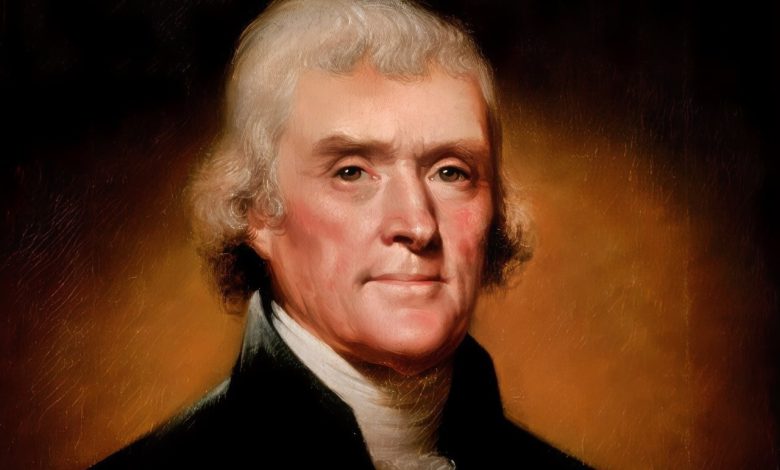
Military Quote of the Day by Thomas Jefferson: ‘I abhor war and view it as the greatest scourge of mankind…’

Synopsis: A widely quoted Thomas Jefferson line—“I abhor war and view it as the greatest scourge of mankind”—can read like pure pacifism until you see the full sentence and its context.
-This piece argues Jefferson viewed war as a necessary evil, not a moral good, and highlights the often-overlooked fact that he held militia responsibilities before becoming president.
-It then pivots to Jefferson as commander-in-chief during the First Barbary War, when the United States chose force over tribute to curb piracy and protect commerce.
-The article closes with Jefferson’s enduring legacy—and the contradictions that still shape how Americans remember him.
Thomas Jefferson, the Pacifist? Not Quite—Here’s the Context Behind His Famous War Line
“I abhor war and view it as the greatest scourge of mankind.”—That snippet of a quote belongs to none other than Thomas Jefferson.
Viewed in isolation, those dozen words make this former U.S. President and member of America’s Founding Fathers appear to be a raging pacifist.
However, to put that in its proper context, we must look at the entire sentence (which is part of a letter to Elbridge Gerry dated May 13, 1797): “Much as I abhor war, and view it as the greatest scourge of mankind, and anxiously as I wish to keep out of the broils of Europe, I would yet go with my brethren into these, rather than separate from them.”
Much as Thomas Jefferson abhorred war, he clearly recognized it as a necessary evil.
After all, by serving as the primary author (and one of the signers) of the Declaration of Independence, he was committing an act of war against the British Crown; indeed, the Revolutionary War had already been underway for 15 months by the time the DOI was signed.
He also presided as commander-in-chief during America’s first major war, the First Barbary War (more on this in a bit).
But what is less well known is that this famous politician and scholar also served as a soldier.
Thomas Jefferson the Soldier
An excellent source of information for this segment of Jefferson’s life’s work is the article “WAS THOMAS JEFFERSON IN THE MILITARY?” written by Kevin Lankes for VeteranLife and first published on February 17, 2022.
Therein, we learn that “When Jefferson was just 27 years old, he was appointed to the Albemarle County Militia by the Governor of Virginia…As it happens, he started right out of the gate with the rank of colonel. In 1770, 31 years before he was elected to the presidency, Jefferson began his military career by preparing the Virginia militia for battle. He kept the muster rolls, led regular drills, and made sure that any money owed to the sheriff for the militia was paid up.”
Moreover, we learn from a December 14, 2014, article by GunPundit Team on The Civil War website (yes, I know, not a very original name) that Jefferson also held an officer’s commission during the Revolutionary War.
In 1779, Jefferson was appointed as a Major in the Continental Army by General Henry Knox (Chief Artillery Officer of the Continental Army and later America’s first Secretary of War). Maj. Jefferson was assigned to command a battalion of Virginia militia, which he led in several battles against British forces.
The most significant of these battles was the Battle of Yorktown in October 1781, wherein Jefferson’s battalion played a crucial role in the siege of British General Charles Cornwallis’s forces.
Thomas Jefferson, the Commander-in-Chief: The First Barbary War
The short version is that it lasted from May 10, 1801, to June 10, 1805. The Barbary pirates, a radical Islamist enemy based in Ottoman Tripolitania (Eyālet-i Trâblus Gârb; roughly corresponding to the northern parts of modern-day Libya), were attacking European and American merchant shipping with seeming impunity.
Pasha Yusuf Karamanli demanded from the United States an increase in the tribute ($83,000) which it had paid since 1796 for the protection of their commerce and enslavement of crews.
President Jefferson refused to pay that tribute, instead ordering the U.S. Navy and Marine Corps to Tripoli in 1801 to repel “force with force.”
The First Barbary War made heroes and legends of young officers such as William Bainbridge, Stephen Decatur, Isaac Hull, David Porter, and Presley O’Bannon.
Indeed, it was USMC First Lieutenant Presley Neville O’Bannon, later known as the “Hero of Derne,” who led the successful attack at the Battle of Derna on April 27, 1805, and thus gave the Marines’ Hymn its line “to the shores of Tripoli.” In the process, he also became the first man to raise a United States flag over foreign soil in time of war.
For further reading on the First Barbary War, I highly recommend the excellent book “Jefferson’s War: America’s First War on Terror 1801-1805” by Joseph Whelan. I read it in 2013 during my second Iraq tour (at the Port of Umm Qasr), and it definitely helped to pass away the downtime as I counted down the days until I could finally go on R&R.
Lasting Legacy and My Own Thomas Jefferson Experience
Where to begin?
The most obvious examples that most Americans (even the ones that aren’t hardcore history buffs) will recognize are: (1) President Jefferson’s face on the $2 bill (first minted during America’s bicentennial year appropriately enough; I used to collect these as a wee-bitty lad); (2) the Jefferson Memorial in Washington, DC; and (3) Monticello.

Monticello Thomas Jefferson Original Image. Image by Christian D. Orr/19FortyFive
I’ve toured both the Memorial and Monticello and recommend them highly.

Thomas Jefferson Burial. Image provided by the Author, Christian D. Orr/19FortyFive.com
Regarding the latter, it should, of course, be acknowledged that Jefferson, like any hero, was a human being with his own fair share of flaws and imperfections, and accordingly, the exhibits at Monticello are quite candid in their assessments of Jefferson’s controversial affair with his slave Sally Hemings.
Meanwhile, one of the most memorably witty tributes to Thomas Jefferson was paid by JFK during an April 29, 1962 dinner at the White House honoring Nobel Prize winners from the Western Hemisphere: “I think this is the most extraordinary collection of talent, of human knowledge, that has ever been gathered together at the White House, with the possible exception of when Thomas Jefferson dined alone.’”
About the Author: Christian D. Orr, Defense Expert
Christian D. Orr is a Senior Defense Editor. He is a former Air Force Security Forces officer, Federal law enforcement officer, and private military contractor (with assignments worked in Iraq, the United Arab Emirates, Kosovo, Japan, Germany, and the Pentagon). Chris holds a B.A. in International Relations from the University of Southern California (USC) and an M.A. in Intelligence Studies (concentration in Terrorism Studies) from American Military University (AMU). He is also the author of the newly published book “Five Decades of a Fabulous Firearm: Celebrating the 50th Anniversary of the Beretta 92 Pistol Series.”