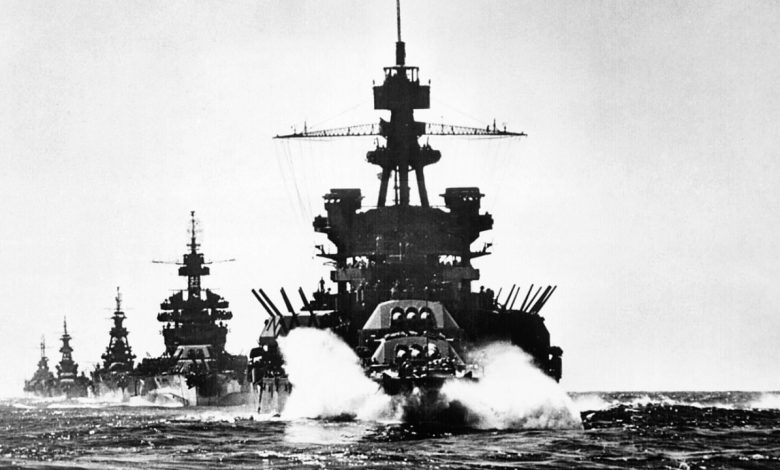
32,000 Tons of Raw Power: The Pennsylvania-Class Battleships Have Something to Say to the U.S. Navy

Pennsylvania-Class Battleships: 12 14-Inch Guns And The Navy’s “Standard-Type” Leap
The Pennsylvania-class of battleships was relatively small as far as battleship classes go — just two ships in total, the USS Pennsylvania and the USS Arizona, but they marked a transition in the U.S. Navy from the early dreadnought designs toward a more mature capital-ship class of ship in the lead up to the First World War.
First authorized in 1913 and completed during the war in 1916 and 1917, the ships were the first in the burgeoning United States Navy to operate under the “standard-type” operating concept — in essence, ships intended to operate in conjunction with other ships at the tactical level.
To that end, the ships across classes would operate at similar speeds, with similar turning radii, and generally similar handling characteristics.
Standard-type Warships
It was not any single design characteristic that made the Pennsylvania-class distinctive, but rather several factors in combination. They were the first American warships to mount 12 14-inch main guns, arranged in 4 triple turrets, allowing heavy broadsides without a significantly lengthened hull.
But the ships also introduced the all-or-nothing armor concept to American battleship design. Unlike previous battleships, which attempted to armor most of the ship, this armoring choice prioritized the most important areas and afforded them the most armor protection.
Command stations, magazines, and propulsion areas were some of the most heavily-protected areas of the ship, whereas less critical areas received little or no armor protection. And unlike previous generations of warship, the Pennsylvania-class was oil-powered rather than coal, affording a smaller crew, greater operational range, and better logistical flexibility, particularly given the United States’ growing influence in the Pacific — as well as that of Imperial Japan.
A Global Power
The two ships of the class, the USS Pennsylvania and the USS Arizona, entered service with the United States Navy at a time when the country was asserting itself more forcefully on the world stage, but before it had a clear idea of what role its fleet would play in a wartime scenario.
During the First World War, both ships were primarily used as readiness and training ships. At the time, the British Royal Navy dominated the North Sea thanks to its own Grand Fleet. Combined with oil logistics challenges in Europe, neither of the Pennsylvania-class ships saw combat.
Instead, they operated primarily from American naval bases.
In the interwar years between world wars, they did, however, become an important component of the United States Pacific Fleet, and participated in a number of exercises that would shape American naval doctrine, and in particular the kinds of long-range operations that would define operations in the Pacific theatre during the Second World War.
The Second World War
Unfortunately for the Pennsylvania class, the more modern battleships that followed them made the class less advanced, though both ships still had some military value.
The USS Arizona was infamously destroyed during the Imperial Japanese attack on Pearl Harbor on December 7th, 1941, after a Japanese armor-piercing bomb tore into one of the ship’s magazines and ripped the battleship apart. 1,777 officers and men died, making the ship the source of the greatest loss of life that day.
Today, the ship’s wreck remains in place, a war memorial and grave marker of that attack, and also a marker of what would become the United States entry into the Second World War.
In contrast, the USS Pennsylvania survived that day with relatively light damage, a consequence of the ship being in dry dock at the time of the attack. But after some repairs and modernization, the boat would have a long career in the U.S. Navy.
During the Aleutian campaign, the USS Pennsylvania provided troops on the ground with gunfire support and also supported amphibious landings elsewhere in the Pacific, including Okinawa, Guam, Leyte, and Saipan.
But these roles reflected the ship’s increasing obsolescence in the face of much more modern battleships and the threat posed by naval aviation. Rather than engaging other capital ships, the USS Pennsylvania would instead apply its large main guns to support roles, bombarding shore batteries and making way for the carriers that would carry fleet combat.
Postwar Role and the Nuclear Age
After the Japanese surrender, the USS Pennsylvania’s utility rapidly shrank — but her last mission was nuclear in nature.

The “Baker” explosion, part of Operation Crossroads, a nuclear weapon test by the United States military at Bikini Atoll, Micronesia, on 25 July 1946. The wider, exterior cloud is actually just a condensation cloud caused by the Wilson chamber effect, and was very brief. Image Credit: Creative Commons.
During the 1946 nuclear tests at Bikini Atoll, the ship was used as target practice. And while the ship did survive a pair of nuclear explosions, the high levels of radiation the ship absorbed rendered it useless for combat, and the U.S. Navy ultimately scuttled the ship in 1948.
About the Author: Caleb Larson
Caleb Larson is an American multiformat journalist based in Berlin, Germany. His work covers the intersection of conflict and society, focusing on American foreign policy and European security. He has reported from Germany, Russia, and the United States. Most recently, he covered the war in Ukraine, reporting extensively on the war’s shifting battle lines from Donbas and writing on the war’s civilian and humanitarian toll. Previously, he worked as a Defense Reporter for POLITICO Europe. You can follow his latest work on X.