Key Points and Summary – The Trump administration is escalating pressure on Nicolás Maduro by calling for a “total and complete” blockade of sanctioned oil tankers entering or leaving Venezuela, as U.S. air and naval activity grows across the Caribbean.
-Flight trackers spotted Super Hornets operating near the Gulf of Venezuela, with an EA-18G Growler nearby—moves experts say could probe air defenses and collect signals intelligence.
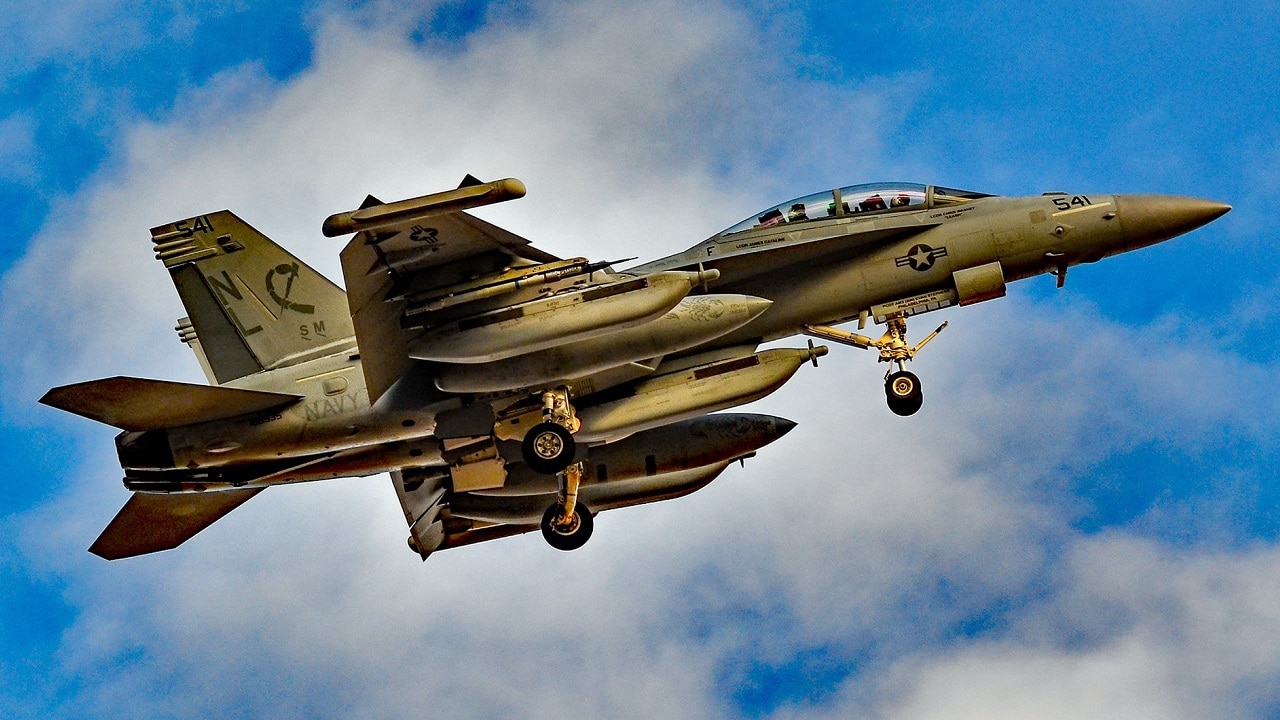
EA-18G Growler. Image Credit: Creative Commons.
-The deployments follow months of strikes on alleged drug-running vessels and reported covert action.
-Supporters see leverage; critics warn that forcing regime collapse could fracture Venezuela and destabilize the region.
-Some analysts think it could work, but risks chaos.
Growlers, B-1B Lancers, and a Blockade: The U.S. Escalation Off Venezuela’s Coast
Fort Lauderdale, Florida – The Trump administration this week called for “a total and complete” blockade of all sanctioned oil tankers entering and leaving Venezuela. As of last week, more than 30 of the 80 ships in Venezuelan waters or approaching the country were under U.S. sanctions, according to data compiled by TankerTrackers.com.
This escalatory move was denounced by Caracas as “warmongering threats,” and others warn that such a blockade could create more problems in Latin America than it solves.
More than one regional specialist commenting on the Trump strategy has said it could succeed in forcing strongman Nicolás Maduro from power. But the risk, according to a commentator speaking to Time magazine, is that “forcefully breaking the Maduro regime could break Venezuela itself—and spur chaos in our own hemisphere.”
Washington began a major build-up of military force in the Caribbean in August, and in September it announced the beginning of a campaign against narcotics smuggling with a strike on an alleged drug-running boat off the coast of Venezuela. Strikes have since been conducted with regularity. In October, U.S. President Donald Trump confirmed that the CIA is carrying out covert operations inside Venezuela against regime targets.
Super Hornets on the Move
A week ago, two U.S. Navy F/A-18E/F Super Hornet fighter jets were tracked circling the Gulf of Venezuela while the war of words and backchannel pressure on Maduro continued to ratchet up.
The Super Hornets were observed on flight-tracking sites operating near Maracaibo, which is Venezuela’s second-largest city. They then circled the gulf for roughly 40 minutes. A Pentagon official told the Associated Press the jets performed a “routine training flight” in the area near Maracalbo.
This incident occurred as reporting steadily increased on the U.S. strikes in the Caribbean Sea against alleged drug-running vessels. The Trump White House said the strikes were intended as a deterrent against narcotics trafficking to the U.S. from Venezuela. Specialists well-versed in narcotics cartels’ typical patterns of operations have raised questions over the legality of the strikes, which have killed more than 80 people.
In an interview with Politico the day before the jets approached Venezuela’s coastline, Trump declared that Maduro’s days in power were “numbered,” but he declined to comment on whether U.S. troops would be deployed to the country.
Growlers and Lancers
During the Super Hornets’ flight, an EA-18G Growler also appeared on the flight-tracking platforms. Data shows the Growler flew in a loop pattern just north of Venezuela’s coast.
The Growler adds an extensive electronic warfare (EW) suite to the two-seat F/A-18F Super Hornet platform. When the jet replaced the decades-old four-seat EA-6B Prowler, it was the first newly designed EW aircraft introduced in more than 35 years.
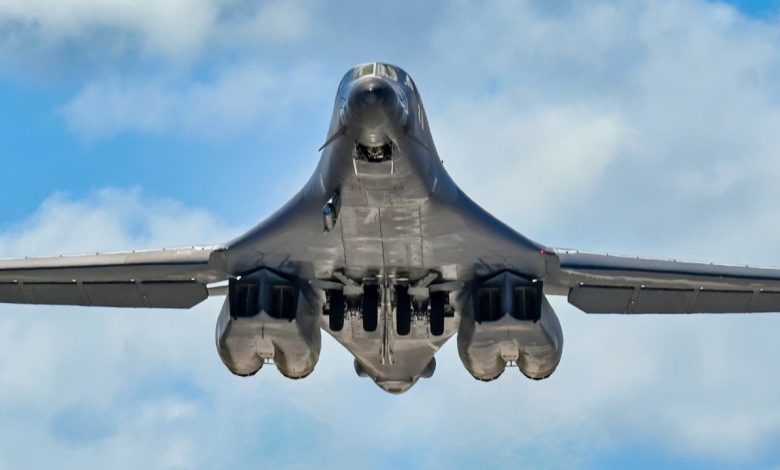
This mission was one of the latest in a series of unusual aviation movements tracked since September. Previously, B-52 Stratofortress and B-1 Lancer bombers flew up to and along the Venezuelan coast.
But the F/A-18E/F models can strike targets both on the ground and in air-to-air engagements. They are the first aircraft to approach the Venezuelan coastline so publicly. The Super Hornets flew to within 20 nautical miles of the coast, according to flight tracking data, and unnamed U.S. officials said the jets remained in international airspace.
The Super Hornets reportedly flew six loops up and down the Gulf of Venezuela. Meanwhile, the Growler jet also flew circles along the coast.
Greg Bagwell, a former Royal Air Force air marshal and president of the Air and Space Power Association, told the BBC the aircraft could be making “probing” approaches to look for the gaps in Venezuelan air defenses and to intercept radio traffic and encrypted signals related to defense systems.
“The Growlers would have been listening for [signals intelligence], whilst the Super Hornets would have been providing air defence cover for the Growlers,” Baswell said. He said the Growlers would also detect “active missile sites”.
“It could be construed as the early gathering of intelligence for subsequent [offensive] operations, or just a warning of such,” he added.
About the Author: Reuben F. Johnson
Reuben F. Johnson has thirty-six years of experience analyzing and reporting on foreign weapons systems, defense technologies, and international arms export policy. Johnson is the Director of Research at the Casimir Pulaski Foundation. He is also a survivor of the Russian invasion of Ukraine in February 2022. He worked for years in the American defense industry as a foreign technology analyst and later as a consultant for the U.S. Department of Defense, the Departments of the Navy and Air Force, and the governments of the United Kingdom and Australia. In 2022-2023, he won two awards in a row for his defense reporting. He holds a bachelor’s degree from DePauw University and a master’s degree from Miami University in Ohio, specializing in Soviet and Russian studies. He lives in Warsaw.