

Trading bots have become key tools in the cryptocurrency world. They handle trades automatically, helping users buy and sell assets without constant watching. For businesses building crypto platforms, understanding these bots matters a lot. This blog compares crypto algorithmic trading bots and traditional bots. We break down how they work, their differences, strengths, and weaknesses. By the end, you’ll see which fits your exchange needs.
Businesses often turn to cryptocurrency exchange development services to create platforms that support advanced trading features. These services build systems where bots run smoothly, process high volumes, and stay reliable during market swings. Whether you run a spot exchange or add futures trading, bots draw in active traders. Let’s dive into the two main types.
What Are Traditional Trading Bots?
Traditional trading bots follow fixed rules set by users. You tell the bot exactly what to do, like “buy Bitcoin if the price drops to $50,000” or “sell Ethereum when it rises 5%.” These bots check market data against your rules and act right away.
They started in the early days of stock trading but moved to crypto as exchanges grew. In crypto, traditional bots connect to exchange APIs. This lets them read prices, place orders, and manage positions.
How Traditional Bots Work
Traditional bots operate on simple logic:
- Rule Input: Users define conditions using if-then statements. For example, if RSI (Relative Strength Index) goes below 30, buy; if above 70, sell.
- Data Check: The bot pulls live data from the exchange, such as price charts or order books.
- Action: It executes trades via API calls — market orders, limit orders, or stops.
- Loop: It repeats this process every few seconds or minutes.
Popular examples include 3Commas, Cryptohopper, and Gunbot. These tools offer drag-and-drop interfaces for non-coders.
Strengths of Traditional Bots
- Easy Setup: No coding needed. Pick from templates like grid trading (buy low, sell high in a range) or DCA (Dollar-Cost Averaging, buying fixed amounts over time).
- Full Control: You set every rule, so the bot matches your exact strategy.
- Low Cost: Many run on personal computers or cheap cloud servers. Basic versions cost $10–50 per month.
- Reliable in Stable Markets: They shine when patterns repeat, like range-bound prices.
For instance, during a sideways market, a grid bot places buy orders below the current price and sell orders above. It profits from small swings without predicting big moves.
Weaknesses of Traditional Bots
- No Adaptability: Rules stay fixed. If the market shifts — like a sudden bull run — the bot keeps selling too early.
- Missed Opportunities: They ignore complex signals, such as news events or on-chain data.
- Over-Optimization Risk: Backtesting on past data often fails in live trading due to changing conditions.
- Manual Tweaks: You must update rules often, which takes time.
In volatile crypto markets, where Bitcoin can jump 10% in hours, traditional bots struggle. A DCA bot might buy steadily during a crash but sell too soon in a recovery.
What Are Crypto Algorithmic Trading Bots?
Crypto algorithmic trading bots use code and math models to make decisions. They analyze data with algorithms — step-by-step processes that spot patterns humans miss. These bots learn from data or adjust strategies in real time.
In crypto exchanges, they handle high-frequency trades, arbitrage across platforms, or market-making (providing buy/sell quotes for fees). Firms like Jump Trading and Alameda Research (before its issues) built custom ones.
How Algorithmic Bots Work
These bots rely on advanced steps:
- Data Input: They gather vast amounts — from price ticks and volumes to social sentiment, blockchain metrics, or even weather data for energy coins.
- Analysis: Algorithms process this. Machine learning models predict prices; statistical arbitrage finds price gaps between exchanges.
- Decision: The bot weighs options and trades. It might use reinforcement learning to test actions and improve.
- Feedback Loop: Results feed back to refine the model.
Open-source options like Freqtrade or Hummingbot let developers build them. Paid platforms like QuantConnect offer cloud-based tools.
Strengths of Algorithmic Bots
- Smart Adaptation: They adjust to market changes. A momentum algorithm speeds up in trends and slows in choppy times.
- Speed and Scale: Handle thousands of trades per second, key for arbitrage (buy low on Binance, sell high on Coinbase).
- Data-Driven: Use stats like moving averages, Bollinger Bands, or neural networks for better signals.
- Backtesting Power: Test on years of data with walk-forward analysis to avoid overfitting.
Take arbitrage: An algo spots a 0.5% price difference in Ethereum between two exchanges, executes in milliseconds, and pockets the gap minus fees.
Weaknesses of Algorithmic Bots
- Complexity: Building requires coding skills in Python or C++. Debugging fails costs money.
- High Costs: Servers, data feeds (like Kaiko or CoinAPI), and devs add up — $1,000+ monthly for pros.
- Black Box Risk: Machine learning decisions can seem random, leading to unexpected losses.
- Data Needs: Poor data means poor results. Free sources often lag.
During the 2022 crypto winter, some algos amplified losses by chasing false signals in low-liquidity markets.
Key Differences: Side-by-Side Comparison
To pick the right bot for your exchange, compare them directly. Here’s a breakdown:
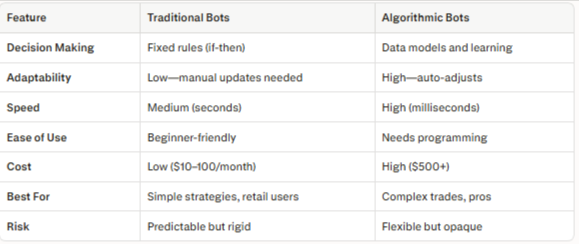
Traditional bots suit casual traders with set-it-and-forget-it needs. Algorithmic ones fit institutions chasing edges in speed or data.
Performance in Real Scenarios
- Bull Market: Algorithmic bots win by riding trends with momentum models. Traditional ones lag if rules cap gains.
- Bear Market: Traditional DCA bots average down steadily. Algos might short-sell better but risk over-leveraging.
- Sideways Market: Grid traditional bots collect small wins. Algos use mean reversion to predict bounces.
A 2023 study by Kaiko showed algo bots outperforming by 15–20% in high-volume pairs like BTC/USDT, but traditional bots held steady in alts.
Use Cases in Cryptocurrency Exchanges
Exchanges thrive when bots boost volume. Traditional bots attract retail users — think mobile apps with one-click setups. They drive 30–40% of spot trading volume on platforms like Binance.
Algorithmic bots power pro features: perpetual futures, options, or cross-exchange arbitrage. They provide liquidity via market-making, earning rebates. For example, Hummingbot users quote bids/asks on your exchange, tightening spreads.
Building Bot-Friendly Exchanges
When developing an exchange, plan for both:
- API Support: REST and WebSocket for real-time data.
- Rate Limits: Allow 100+ requests/second without bans.
- Security: IP whitelisting, API keys with trade-only perms.
- Backtesting Tools: Let users test bots on historical data.
Hybrid approaches work best. Offer traditional bots for starters, with algo SDKs for devs.
Risks and Best Practices for Both
No bot is foolproof. Common pitfalls:
- Flash Crashes: Bots amplify drops by mass-selling.
- API Downtime: Exchanges glitch; bots fail open.
- Fees Eat Profits: High-frequency trading racks up costs.
- Regulations: Check KYC/AML rules for bot trades.
Mitigate with:
- Risk limits: Max position sizes, stop-losses.
- Monitoring: Alerts for drawdowns over 5%.
- Diversification: Run multiple strategies.
- Paper Trading: Test live without real money.
For exchanges, add bot dashboards showing API usage and P&L.
Real-World Examples and Case Studies
Traditional Bot Success: A trader using 3Commas’ grid bot on Solana during 2024’s meme coin hype. It traded in a $0.50–$0.70 range, netting 25% monthly from volatility.
Algo Bot Edge: Jane Street’s crypto arm uses algos for ETF arbitrage post-SEC approvals. They exploit tiny spreads across 10 exchanges, trading billions yearly.
Failure Lessons: In May 2021, bots triggered a cascade on Binance, wiping $10B in hours. Rigid traditional bots sold en masse; algos piled on with leverage.
Platforms like Bybit now cap bot leverage to prevent repeats.
Future Trends in Trading Bots
AI integration grows. Hybrid bots combine rules with light machine learning. Web3 bots on Solana or Ethereum use smart contracts for trustless execution.
Decentralized exchanges (DEXs) like dYdX run on-chain bots, cutting central risks. Expect more no-code algos via tools like TensorTrade.
For exchanges, support these via plugins. Volume could double as retail adopts.
Why Choose the Right Bots for Your Exchange?
Bots drive 70%+ of crypto volume. Traditional ones onboard users fast; algos keep whales trading. Pick based on your audience — retail or institutional.
Ready to build a cryptocurrency exchange that supports top-tier trading bots? Contact Codezeros today for expert cryptocurrency exchange development services. Our team delivers secure, scalable platforms with full API integration.
A message from our Founder
Hey, Sunil here. I wanted to take a moment to thank you for reading until the end and for being a part of this community. Did you know that our team run these publications as a volunteer effort to over 3.5m monthly readers? We don’t receive any funding, we do this to support the community.
If you want to show some love, please take a moment to follow me on LinkedIn, TikTok, Instagram. You can also subscribe to our weekly newsletter. And before you go, don’t forget to clap and follow the writer️!
Crypto Algorithmic Trading Bots vs. Traditional Bots: A Guide for Exchange Builders was originally published in Artificial Intelligence in Plain English on Medium, where people are continuing the conversation by highlighting and responding to this story.