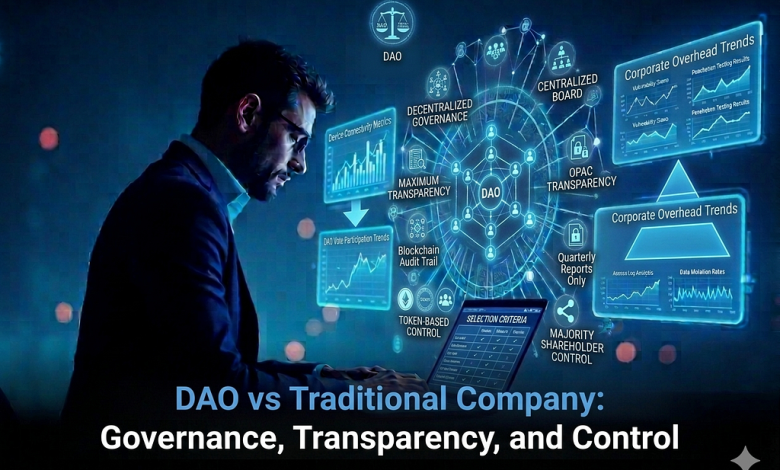
The way organizations operate is evolving rapidly. For decades, traditional companies have dominated the business landscape with centralized leadership and hierarchical decision-making. But with the rise of blockchain technology, Decentralized Autonomous Organizations (DAOs) are challenging that model — offering a new way to manage governance, transparency, and control.
If you’re a founder, investor, or decision-maker exploring modern business structures, understanding the differences between DAOs and traditional companies is essential. This guide breaks it down clearly, helping you evaluate which model aligns better with your goals in 2026 and beyond.
What Is a Traditional Company?
A traditional company operates with a centralized structure where decisions are made by executives, managers, or a board of directors.
Key Characteristics:
- Hierarchical decision-making
- Centralized authority
- Limited transparency
- Legal and regulatory frameworks already established
This model has been effective for decades, providing stability and clear accountability. However, it also introduces inefficiencies, especially in large organizations where decision-making can be slow.
What Is a DAO (Decentralized Autonomous Organization)?
A DAO is a blockchain-based organization governed by smart contracts and community voting instead of centralized leadership.
Key Characteristics:
- Decentralized governance
- Transparent operations
- Automated execution via smart contracts
- Token-based participation
DAOs are built using advanced Blockchain Development Solutions, enabling organizations to operate without relying on traditional intermediaries.
Governance: Centralized vs Decentralized
Traditional Company Governance
In a traditional setup:
- Executives make strategic decisions
- Shareholders vote periodically
- Employees follow a top-down structure
Pros:
- Clear leadership
- Faster decisions in small teams
- Established legal systems
Cons:
- Limited stakeholder participation
- Risk of biased decision-making
- Lack of agility in large organizations
DAO Governance
DAOs operate through decentralized governance models.
How It Works:
- Members hold governance tokens
- Proposals are submitted and voted on
- Smart contracts execute approved decisions
Pros:
- Inclusive decision-making
- Community-driven innovation
- Reduced reliance on intermediaries
Cons:
- Slower consensus in large communities
- Requires strong governance design
- Regulatory uncertainty
A professional Blockchain Development Company ensures that DAO governance frameworks are structured efficiently and securely.
Transparency: Closed Systems vs Open Ledgers
Transparency in Traditional Companies
Traditional businesses often operate with limited transparency.
Examples:
- Financial data shared only with stakeholders
- Internal decisions not publicly visible
- Limited accountability
This lack of visibility can sometimes lead to trust issues among customers and investors.
Transparency in DAOs
Transparency is one of the biggest advantages of DAOs.
Features:
- All transactions recorded on blockchain
- Public access to governance decisions
- Immutable records
Benefits:
- Increased trust
- Reduced fraud
- Enhanced accountability
With DAO Consulting Services, organizations can design transparent systems that balance openness with privacy.
Control: Authority vs Distributed Ownership
Control in Traditional Companies
Control is centralized.
Structure:
- Executives hold decision-making power
- Shareholders influence major decisions
- Employees execute tasks
Challenges:
- Power concentration
- Risk of misalignment with stakeholders
- Limited flexibility
Control in DAOs
Control is distributed among members.
Structure:
- Token holders participate in decisions
- Smart contracts enforce rules
- No single point of authority
Advantages:
- Democratized ownership
- Reduced dependency on leadership
- Greater alignment with community goals
However, designing effective control mechanisms requires expertise in Blockchain Development Service frameworks. Codezeros brings deep technical knowledge to build secure, scalable, and well-governed blockchain systems. Their solutions help businesses implement robust controls while maintaining transparency and efficiency. With the right approach, organizations can confidently manage decentralized operations and long-term growth.
Automation and Efficiency
Traditional Companies
Operations often rely on:
- Manual processes
- Human approvals
- Intermediaries
This can slow down workflows and increase operational costs.
DAOs
DAOs leverage automation through smart contracts.
Benefits:
- Instant execution of decisions
- Reduced operational overhead
- Minimized human error
With the integration of AI and automation in 2026, DAOs are becoming even more efficient, especially when combined with intelligent systems.
Role of AI and 2026 Trends in DAO vs Traditional Models
The gap between DAOs and traditional companies is widening due to emerging technologies.
1. Agentic AI in DAOs
Autonomous agents can:
- Execute governance decisions
- Optimize resource allocation
- Monitor system performance
2. AI in Traditional Companies
Traditional businesses are also adopting AI, but:
- Decision-making remains centralized
- Automation is limited by hierarchy
3. Hybrid Models
Many organizations are now combining:
- Traditional structures for compliance
- DAO frameworks for governance
This hybrid approach is becoming a key trend in enterprise adoption.
Use Cases: Where Each Model Works Best
Traditional Companies Are Ideal For:
- Highly regulated industries
- Established corporate structures
- Businesses requiring strict control
DAOs Are Ideal For:
- Web3 startups
- Community-driven platforms
- Decentralized finance (DeFi)
- Open-source projects
Challenges in DAO Adoption
Despite their advantages, DAOs come with challenges:
1. Regulatory Uncertainty
Legal frameworks are still evolving.
2. Governance Complexity
Poor design can lead to inefficiencies.
3. Security Risks
Smart contract vulnerabilities can be exploited.
4. User Adoption
Requires education and onboarding.
This is why partnering with experts offering DAO Consulting Services is crucial for successful implementation.
How a Blockchain Development Company Bridges the Gap
Transitioning from a traditional model to a DAO requires careful planning and execution.
A skilled Blockchain Development Company helps by:
1. Designing Governance Models
Creating efficient voting and decision-making systems.
2. Developing Smart Contracts
Automating processes securely.
3. Ensuring Security
Conducting audits and implementing safeguards.
4. Integrating Systems
Combining Web2 infrastructure with Web3 capabilities.
5. Providing End-to-End Support
From strategy to deployment and scaling.
Decision-Making Factors: Which One Should You Choose?
Choosing between a DAO and a traditional company depends on your business goals.
Choose a Traditional Model If:
- You need regulatory clarity
- You require centralized control
- Your operations are highly structured
Choose a DAO If:
- You want community-driven governance
- Transparency is a priority
- You’re building in the Web3 ecosystem
Consider a Hybrid Approach If:
- You want the best of both worlds
- You need compliance and innovation
- You’re scaling a modern digital platform
Conclusion
The debate between DAOs and traditional companies isn’t about replacing one with the other — it’s about evolution.
In 2026, the most successful organizations are those that:
- Embrace decentralization where it adds value
- Maintain structure where it’s necessary
- Leverage technology for efficiency and trust
With the right Blockchain Development Solutions, businesses can create flexible models that adapt to changing market demands.
Build the Right Governance Model for Your Business
Whether you’re exploring DAOs, optimizing traditional structures, or building a hybrid model, having the right technical and strategic support makes all the difference.
If you’re ready to explore decentralized governance or need expert guidance, connect with a team specializing in Blockchain Development Service and DAO architecture.
Start your journey Contact us today, Build smarter, more transparent, and future-ready organizations — starting today.
DAO vs Traditional Company: Governance, Transparency, and Control was originally published in Artificial Intelligence in Plain English on Medium, where people are continuing the conversation by highlighting and responding to this story.