Cybersecurity threats are evolving faster than most organizations can keep up with. Data breaches, ransomware attacks, and identity fraud — the list grows longer every year. Blockchain Development Company solutions, however, are emerging as a powerful response, while businesses continue to scramble to patch vulnerabilities and tighten firewalls. Meanwhile, blockchain technology has quietly been building a strong case for itself as one of the most robust security frameworks available today.
Why Traditional IT Security Falls Short
Before diving into blockchain’s strengths, it’s worth acknowledging why conventional security models struggle. Most traditional systems rely on centralized architectures — a single point of control that also becomes a single point of failure. If a hacker breaches the central server or database, the entire system is compromised.
Add to that the complexity of managing access credentials, the risk of insider threats, and the challenge of maintaining data integrity across distributed teams — and it becomes clear why organizations are exploring alternative security models.
This is where blockchain development solutions step in.
How Blockchain Strengthens IT Security
1. Decentralization Eliminates Single Points of Failure
The most fundamental security advantage of blockchain is its decentralized structure. Instead of storing data on a single server, blockchain distributes it across a network of nodes. For an attacker to tamper with the data, they would need to simultaneously alter every copy across the network — a feat that’s computationally infeasible in most real-world scenarios.
This architecture makes blockchain inherently resilient to DDoS attacks, data tampering, and unauthorized access attempts that routinely exploit centralized systems.
2. Immutable Data Records
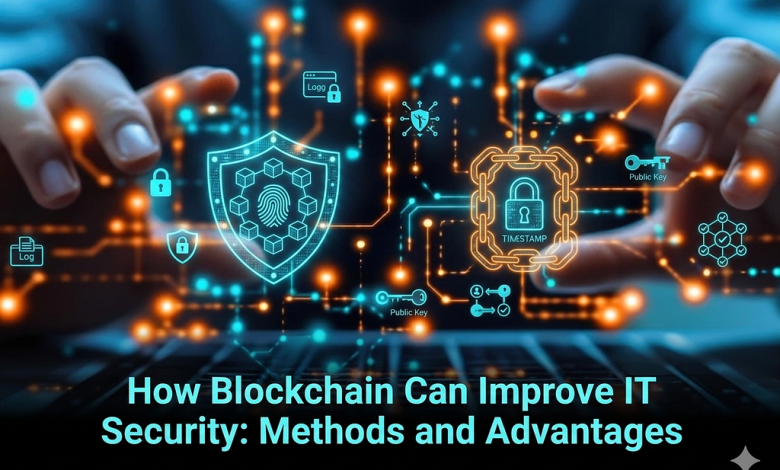
Once a transaction or data entry is written to the blockchain, it cannot be altered or deleted without consensus from the network. Each block contains a cryptographic hash of the previous block, creating a tamper-evident chain. Any attempt to modify historical records breaks the chain — and the network immediately flags it.
For industries dealing with sensitive records — healthcare, finance, legal, supply chain — this immutability is a game-changer. It ensures data integrity and provides an auditable trail of every action taken on the system.
3. Enhanced Identity and Access Management
Identity theft and unauthorized access are among the top causes of security breaches. Traditional username-password systems are notoriously vulnerable. Blockchain offers a more secure alternative through decentralized identity (DID) frameworks.
With blockchain-based identity management, users control their own credentials through cryptographic keys instead of relying on centralized identity providers. Authentication becomes tamper-proof, and there’s no central database of credentials for hackers to target.
This approach also supports zero-trust security models, where every access request is verified independently — a standard that’s increasingly essential in remote and hybrid work environments.
4. Secure Data Sharing and Communication
Organizations frequently need to share sensitive data across departments, partners, or vendors. Traditional methods — email, shared drives, APIs — carry significant risks if not properly secured. Blockchain enables encrypted, permissioned data sharing where only authorized parties can access specific information.
Smart contracts further automate and enforce data-sharing rules without requiring a trusted intermediary. Once conditions are met, the contract executes — transparently, automatically, and without the possibility of unauthorized manipulation.
5. Transparent Audit Trails
Security compliance and incident response both depend heavily on audit logs. But traditional logs are often stored in the same systems they’re meant to monitor, making them vulnerable to tampering — especially in insider threat scenarios.
Blockchain creates permanent, timestamped audit trails that are stored across the network. Every access event, transaction, or data modification is recorded immutably. This not only strengthens compliance with frameworks like GDPR, HIPAA, or ISO 27001, but also gives security teams reliable forensic data when incidents occur.
6. Resilience Against Ransomware
Ransomware attacks typically work by encrypting a victim’s files and demanding payment for decryption. Since blockchain data is distributed and immutable, attackers cannot encrypt or delete the original records. Organizations can restore operations from the blockchain ledger without paying the ransom — removing the attacker’s primary leverage.
The Role of DAOs in Decentralized Security Governance
One emerging application worth highlighting is the use of Decentralized Autonomous Organizations (DAOs) in IT security governance. Traditional security policy management is top-down and often slow to adapt. DAO consulting services enable organizations to build governance structures where security policies, access controls, and protocol updates are managed through transparent, on-chain voting mechanisms.
This removes single points of authority that can be compromised or manipulated, and ensures that critical security decisions are made collectively, transparently, and in accordance with pre-set rules. For enterprises managing complex, multi-stakeholder environments, DAO-based governance is becoming an increasingly attractive model.
Key Advantages at a Glance
To summarize, here’s what blockchain brings to the IT security table:
- Decentralization — No single point of failure or attack
- Data immutability — Tamper-evident records with cryptographic assurance
- Decentralized identity — Stronger authentication without centralized credential stores
- Transparent audit trails — Reliable forensic data for compliance and incident response
- Smart contract automation — Enforced security rules without human intermediaries
- Ransomware resilience — Distributed storage neutralizes encryption attacks
Is Blockchain Security Right for Your Organization?
Blockchain isn’t a plug-and-play solution. Implementing it effectively requires understanding your specific threat landscape, integrating it with existing infrastructure, and choosing the right consensus mechanism and network architecture for your use case. That’s where working with an experienced blockchain development company makes a real difference.
Getting the architecture right from the start — whether you’re building a private enterprise blockchain, integrating smart contract-based access controls, or deploying DAO-based governance for security management — is critical to realizing the security benefits without introducing new vulnerabilities.
Conclusion
Blockchain technology isn’t just for cryptocurrency. Its core properties — decentralization, immutability, transparency, and cryptographic security — make it one of the most promising tools for addressing the structural weaknesses in modern IT security, and Codezeros is helping drive this transformation forward.
As cyber threats grow in sophistication, organizations that adopt blockchain-backed security frameworks will be better positioned to protect their data, maintain compliance, and respond to incidents with confidence.
Ready to explore how blockchain development solutions can strengthen your organization’s security posture?
Whether you’re looking to build a custom blockchain security infrastructure, implement smart contract-based access controls, or leverage DAO consulting services for decentralized governance — the right expertise makes all the difference.
👉 Connect with Codezeros — a trusted blockchain development service provider helping enterprises design and deploy secure, scalable blockchain systems. Let’s build something resilient together.
A message from our Founder
Hey, Sunil here. I wanted to take a moment to thank you for reading until the end and for being a part of this community. Did you know that our team run these publications as a volunteer effort to over 3.5m monthly readers? We don’t receive any funding, we do this to support the community.
If you want to show some love, please take a moment to follow me on LinkedIn, TikTok, Instagram. You can also subscribe to our weekly newsletter. And before you go, don’t forget to clap and follow the writer️!
How Blockchain Can Improve IT Security: Methods and Advantages was originally published in Artificial Intelligence in Plain English on Medium, where people are continuing the conversation by highlighting and responding to this story.